




04/09/2026 – Let us return once again to the history of the RIVA Shipyard, a reality that has its roots in the now distant 1842, when Pietro Riva decides to start a boat repair business on Lake Iseo, precisely in Sarnico.
The business grows, like many stories of quality craftsmanship in an era in which the market was made up of simple local supply-demand dynamics and in a moment in which what we proudly define today “made-in-Italy” it was simply the fruit of valuable manual creations full of intuitions, mastery, sense of time.
Carlo Riva follows the evolution of the business in the 50s and 60s like many other historic protagonists of entrepreneurship that Italy has had over the decades, but in addition to function it also comes across beauty, working the mahogany and ensuring that his creations were spotted by that generation of customers who came to Italy to enjoy the good life and many unique views in the world. And from here the history of the Riva shipyard and its iconic boats was born, clear and fast, made to be admired and be admired!
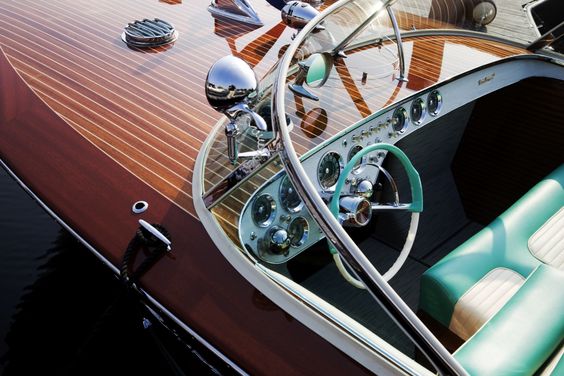
The jet set arriving in Italy in the most glamorous locations climbs aboard RIVA motorboats and the glossy pages of newspapers endlessly immortalize actors and actresses, presenters and business captains in that setting “unmistakably beautiful” made of brushstrokes of color as in an author's painting: the blue of the sea, the white foam of the wake of the engines, the brown of polished wood, the turquoise of the on-board cushions, the ivory of the steering wheel and dashboard knobs inspired by American cars were the backdrop to the myth: the Turtleneck !
The brand takes shape precisely on this evocative image, always repeated, never forgotten, totally identity, silently expressing a fundamental concept: the elegance of time dedicated to beauty.
If we go back to the present day, from this expression we can deduce three key elements of the brand strategy that a company should understand, before moving on the market with actions and communication:
RIVA quickly demonstrates that it has built its brand strategy optimally:
In 1969 the shipyard is sold to an American company and momentarily loses sight of its historic positioning precisely because entrepreneurship needs capital, but above all of culture and vision. After various and further changes of ownership, In the 2000 Norberto Ferretti acquires the shipyard and merges it into the Ferretti Group, bringing together quality, tradition and new technologies, so that the story can take a new, more modern direction but with the knowledge and awareness of the importance of maintaining the historical positioning of the brand. The market has changed in the meantime, the activities gradually extend towards a more complex range and with much larger boats, but with the correct culture of those who know they have a company in their hands with 180 years of history and knows how to carry it forward.
<< Anyone who wants to build a brand or develop a brand, it must start from culture and observation, non dai capitali >> (Davide Diurisi)


